
Designing The Future: AI, Sustainability and Strategy
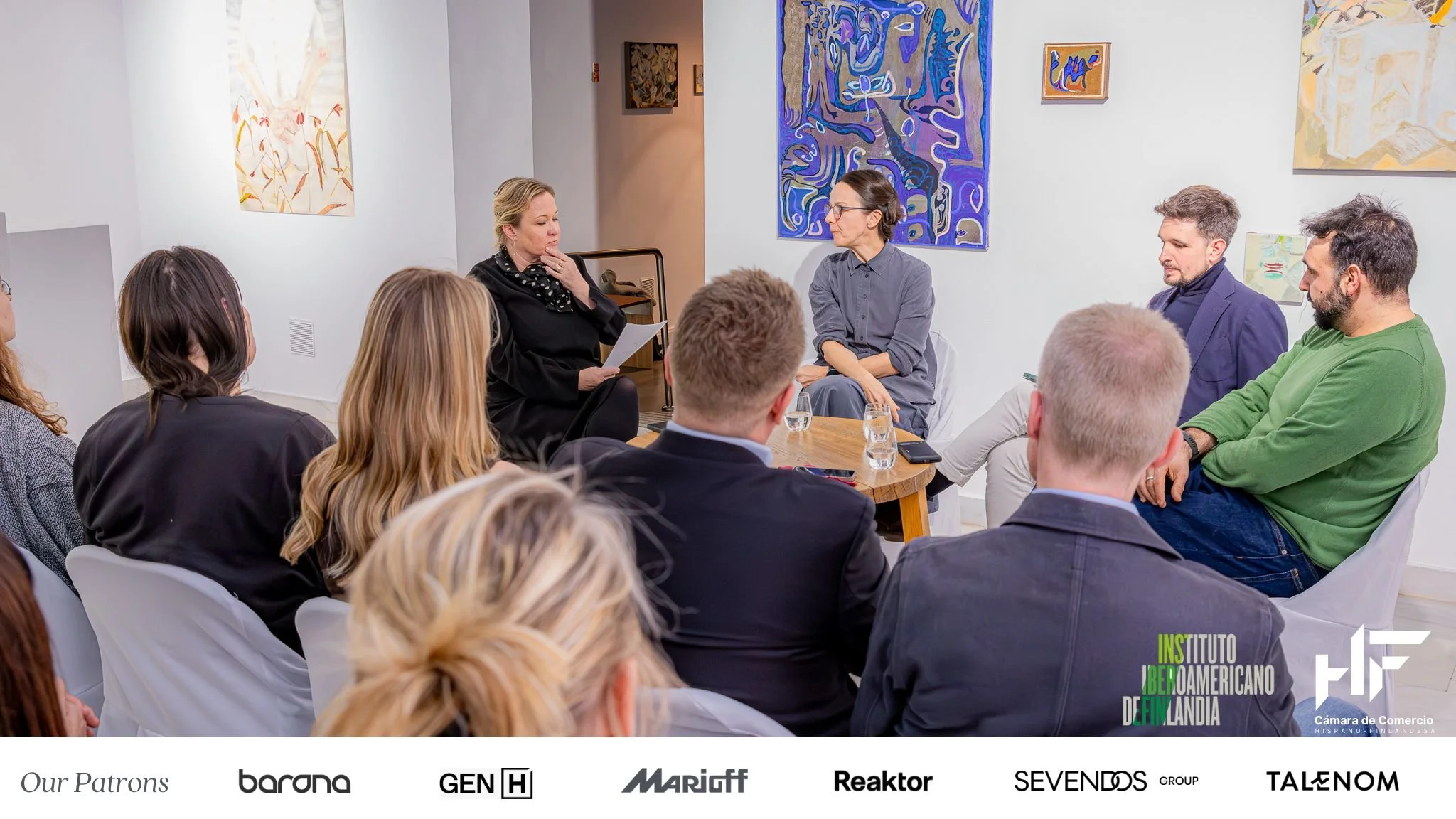
At our recent panel, three experts from different fields shared their visions on the future of design: Clara Llamas, Service Designer and Academic Director at IE University’s School of Architecture and Design, Javier Bailón, New Building Solutions Manager at KONE, and Gianluca Pugliese, Adjunct Professor and Founder of the sustainable 3D printing company, LOWPOLY. The panel was moderated by Suvi Aalto, our Head of Operations and Membership.
The discussion explored three themes: AI as a creative accelerator, sustainability across industries, and the growing strategic role of design in business.
AI as a Creative Accelerator
All three panelists agreed that AI plays a significant role in the future of design. Rather than taking over the creative process, they see it as a tool to accelerate it and make smarter, more informed decisions. Javier described how KONE has been using AI in its maintenance services for several years, enabling the company to predict potential elevator failures before they occur. AI has helped reduce elevator downtime by over 30%, directly improving service reliability and customer satisfaction. Looking ahead, he sees AI playing a growing role in commercial strategy as well, with the potential to predict customer behaviour.
For Gianluca, AI has transformed the way he presents ideas to clients. By training his own AI model to recognise and interpret his hand-drawn sketches, he can now generate detailed renders within minutes. What once took weeks of back-and-forth can now be iterated in a single day, allowing more time for creative and strategic decisions.
Sustainability Is All About the Design
One key insight from the panel was that sustainable design is a way to solve problems more efficiently, whether it is by extending a product’s life for decades or by minimizing waste across its entire lifecycle.
For KONE, sustainability goes far beyond materials or the manufacturing process. Javier emphasized that sustainability in their industry is not achieved at the point of manufacture alone, but through the entire life of the product, designing elevators that last for decades. By designing equipment that is easy to upgrade and repair, KONE reduces the need for full replacements, significantly lowering its carbon footprint. Factors such as how the equipment performs throughout its lifetime, product design choices, the use of digitalization in maintenance or designing with industrialization in mind to reduce installation time on site, also play an important role.
Gianluca shared his perspective on sustainable design: "In my opinion, sustainable design is something that solves a problem. If we can solve a problem in a more efficient way, that for me, is sustainable design." His company LOWPOLY was founded on this idea, spending seven years developing ways to 3D print using recycled and bio-based materials, turning organic waste into new raw material.
Clara also raised a point about responsibility. She argued that designers must be more selective about what they create in the first place. "It is a huge responsibility for designers to really connect the dots, and maybe design less, do fewer things, and think very critically about what is being put out into the world. And how we are acting in it.".
Design at the Core, Not the Finish Line
Design is not a finishing touch but a strategic way of thinking that belongs at the very beginning of the process. Clara backed this up with data from the Design Management Institute: companies with a strong design culture outperform general markets by over 200%.
Another example of design as a strategy comes from Gianluca and his team, who designed the world's first coffee store built from the shop's own coffee waste using 3D printing. Three years later, people are still travelling from around the world just to take a picture of it. As Gianluca put it: "It is another way how design can help a brand, not only with the physical part but by moving or interacting with people.”.
The panel concluded that the future of design lies in solving problems more intelligently by integrating design thinking from the very beginning.